Angry of Wivenhoe
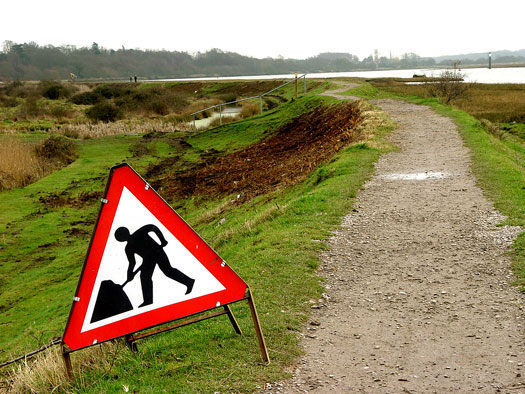
Here’s a letter that has been passed on to me, before being submitted to Richard Houghton, the Team Leader (Strategic Planning) of the Environment Agency, Anglian Coastal Authorities Group.
Phew - that’s quite a title, and one that deserves such a well-reasoned correspondence in relation to the continued vandalism of our natural Wivenhoe habitat by the EA.
I’m not one for letter writing, or even offering up templates for others to simply copy and paste and then pass on. But the sentiments below - penned by a very popular figure within the town - seem to capture perfectly the anger that many have felt over this issue.
There has still been no explanation as to why such a homogeneous national policy has been implemented so savagely within our unique Wivenhoe environment. The arguments are floored, contradictory and plain bad science.
The threat still remains that the diggers will return down to the front before the end of the month. The EA is coming close to its own deadline - whaddya reckon May Fair morning as when we first see (or maybe miss) the EA bully boys once again?
A very fine letter - many thanks for passing on…
Dear Mr Houghton,
I am writing to you regarding the advance notice just received by Wivenhoe Town Council of further vegetation clearance on sea defences which the EA plans to carry out in May, July and September / October of this year.
This represents a significant intensification of what is already regarded as controversial policy, with a radical aim of reducing all vegetation on sea defences to a bland monoculture of turf contravenes all standard policy on wildlife, biodiversity, landscape protection and public amenity.
In the case of Wivenhoe in particular, there is no evidence of damage to seawalls from either brushwood or rabbits, and the assessments in the Shoreline Management Plan make clear there is no problem with carrying out visual inspections. The seawalls downstream border a relatively sheltered stretch of the river Colne, and the seawalls upstream are protected by the Colne barrier.
In view of the damaging impact of this policy, I should be grateful if you could provide answers to the following questions:
Is it correct to assume that the current Sea Defence Vegetation Management programme is being applied to all 300 km. of seawalls in East Anglia which were subject to vegetation clearance in 2010-2011
What are the main drivers of this unprecedented top-down policy initiative? (Implemented in a one-size-fits-all manner, they appear to be mainly political and bureaucratic.)
How much of the annual EA budget for 2011-2012 is being allocated for this purpose? What will be the overall cost?
What is the scientific basis – i.e. published peer-reviewed papers - for adopting a policy which seeks to eliminate all woody growth from sea defences?
Who took the decision, and when was it decided (contrary to assurances received by Wivenhoe residents from EA officials in March) that three further clearance operations would take place in 2011?
Could you identify specific locations in Suffolk / Essex where rabbits have caused significant damage to sea walls?
Can you give an example of an Essex seawall that has failed due to the presence of ‘woody growth’?
Which bodies are monitoring the ecological impact of a regime of cutting up to three times a year – and what flora, apart from grasses, is expected to survive this treatment?
The original report of this management technique in last year’s RFDC minutes stated that you would be creating replacement habitat. Please could you report on your progress with this plan.
Has consideration been given to the likely impact of repeated use of heavy machinery on the structural integrity of seawalls?
And here’s the proposed sites for further sanctioned vandalism in the next round of destruction. Note: the red on the maps published below indicates the intended targets for destruction by the Environment Agency.
Alresford Creek North Bank
Alresford Creek South Bank
Wivenhoe Marsh Farm
Colne Barrier South
East Donyland
Wivenhoe Ferry Marsh